
Peace on Earth
Peace on Earth: Advent Lessons from Luke, John, & John Locke
This is part two of a four-part Advent series written by our teachers reflecting on an advent theme and how that theme is reflected in the Magdalen curriculum.
Glory to God in the highest, and on earth peace among men with whom he is pleased! Luke 2:14
Peace I leave with you; my peace I give to you; not as the world gives do I give to you. Let not your hearts be troubled, neither let them be afraid. John 14:27
The message of peace on earth that the angels gave to the shepherds, announcing the birth of Christ, echoes across the depth of creation—God, in His highest place, grants peace to his people on earth, who glorify Him in return. The Greek word for peace is Εἰρήνη, eirene—emerging from the root eiro, meaning “to join.” Through this gift of peace we can be unified with each other and reunited with God. This is a message of wholeness, of God’s created order set right, a glorious victory that will put an end to the things of this world that are not eirene. So why hasn’t this message been fulfilled? Why are we not yet at peace?
This is a hard idea for me to wrestle with during this time, when injustice, oppression, and war are present everywhere around us. I am not at peace. The world is not at peace. Why then have we been offered it, by a host of angels out of heaven? How can I read Jesus’ words in John telling me not to let my heart be troubled? We believe that Jesus came and died and rose and that a part of his mission was to give us the gift of peace, so why are we still asking for it two thousand years later? Was he wrong? Did he fail? Or are we the ones who have failed, and there is no peace among men because there are none with whom God is pleased?
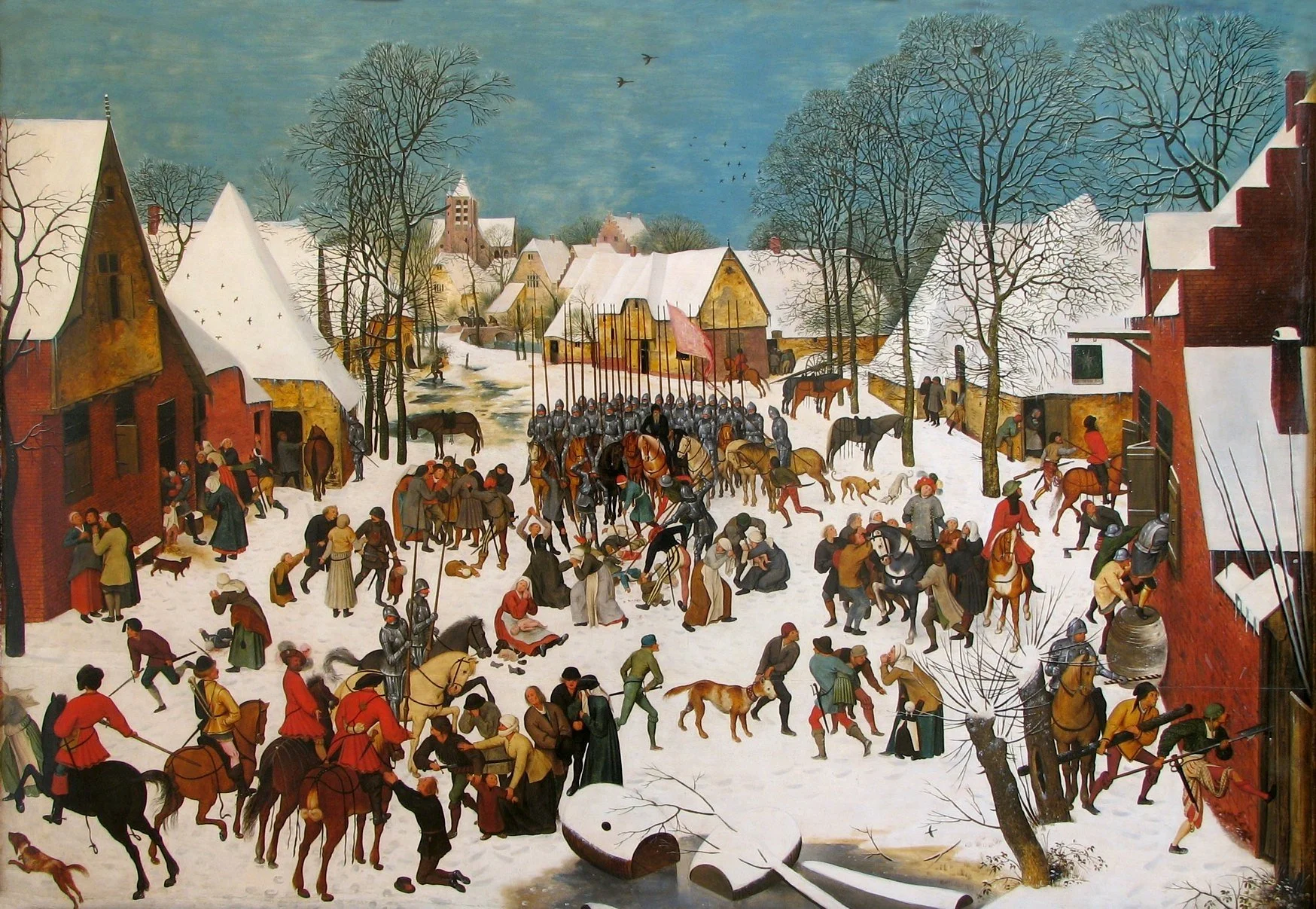
The Massacre of the Innocents by Pieter Breughel the Younger
In our Omnibus America class, we have read John Locke’s Second Treatise of Government, in which he describes a theoretical, idyllic “natural state” of mankind. In this natural state, people live at peace, with no rulers or national division, no war or competition, everyone following the internal moral law that compels love and cooperation. This peace is not possible under a king or ruler, for reasons that require the rest of the book to explain—but Locke’s idea of a peaceful natural state depends entirely on the idea that we are governed solely by the moral law, which comes from God. In this natural state, we serve and love God alone: we have no need of an earthly monarch, because God’s law is perfect and we can follow it justly. This feels familiar—peace comes with the kingdom of God, which is imminent and is coming. Earthly powers still rule us; war is still done. But we know from the advent of Christ that there is a better way, a higher kingdom.
The angels’ message did not mean that there is peace on earth. They announced the coming of a great gift of peace, a promise from the creator that eirene will come, and that God is doing that work of joining together, beginning with the birth of Christ. The work is far from peaceful: Mary talks of scattering the proud, throwing down the powerful from their thrones, and sending the rich away (Luke 1:46-55); Jesus disrupts the normal orders of power and authority, purges the temple with a whip, and defeats death itself in an earth-shaking victory. Our responsibility, as followers of Christ, is to continue the work, living as Christ lived. We are told that there will be hardship and struggle: Jesus promises us directly that “In the world [we] have tribulation.” But these words, like the war and chaos and disjointed suffering that we find ourselves in, are only a part of the whole. The paradox of peace is that there is no eirene now, because the work is not finished; but the work has already been done, Christ has been born, the victory has been won, and eirene is a sure promise.
I have said this to you, that in me you may have peace. In the world you have tribulation; but be of good cheer, I have overcome the world. John 16:33
The work is done, and the work is ongoing. Let there be peace on earth.
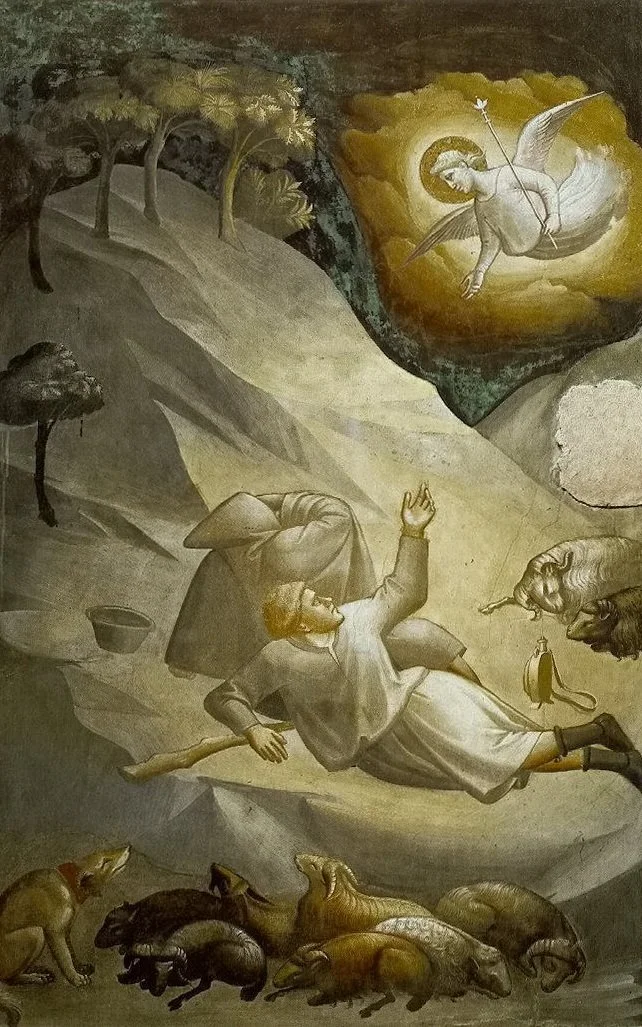
Fresco by Taddeo Gaddi, Basilica of Santa Croce, Florence c. 1300