
On Joy

On Joy: Advent Lessons from Scripture & Poetry
This is part three of a four-part Advent series written by our teachers reflecting on an advent theme and how that theme is reflected in the Magdalen curriculum.
Every December, the word “joy” is suddenly brought to our attention. It ends up on mugs, advertisements, and wall art. A little bit of aesthetic pressure to celebrate a certain way.

JOY
But Christian joy was never meant to be decorative or a performance. I had a discussion recently with some of the Magdalen Seniors about how true joy doesn’t require us to ignore what is hard or unhealed. In Scripture, joy is the architecture of a life oriented toward God, even in the hard times.
When Paul writes, “Rejoice always” (1 Thess. 5:16), he’s not saying to “be happy.” The command sits right next to instructions to pray without ceasing and to give thanks in all circumstances.
Psychologically, joy has far less to do with pleasant emotions than with what we attend to. We know this from cognitive research: attention shapes experience. Our instincts and our thought patterns gravitate toward threat, lack, and unresolved problems which are patterns that once kept us safe but now exhaust us.
As Christians, we are offered a different lens: “The light shines in the darkness, and the darkness did not overcome it” (John 1:5). There is light and we can appreciate it without denying the existence of the dark.

Reaching toward the light
Mary Oliver said that attention is a form of prayer. Scripture would agree. Joy enters exactly there! It’s in these moments when the mind stops needing control for long enough to look around and see the good and beautiful.
This is why joy can coexist with grief or uncertainty: “Weeping may endure for the night, but joy comes in the morning” (Ps. 30:5). Pain is acknowledged without being absolutized. Morning is coming, because God’s character promises it.
Christian joy aims for resilience, not optimism. Optimism is based on prediction. Joy is based on presence.
Joy shows up in prisons (Acts 16), wilderness seasons (Isaiah 35), and exile (Jeremiah 31). These are not necessarily easy environments. What they have in common is a willingness to see God working even when it is not immediately obvious.
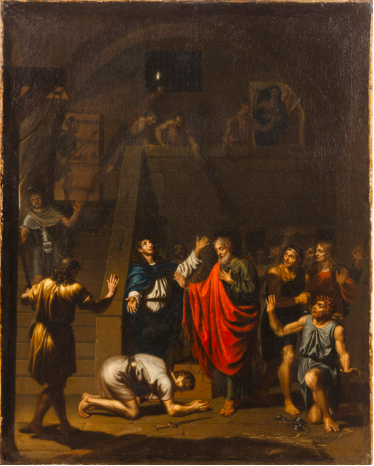
Conversion of the Jailer by Saint Paul, Nicolas de Plattemontagne
So how do we practice joy this season?
There is no perfect formula, but I’ve put together some practices that help me create room for joy:
Slow your assumptions.
Instead of assuming you know what the day will bring, ask God to let you see what you normally overlook.
Name it and feel it.
Acknowledge the tension you’re carrying. Joy is not threatened by honesty.
Create small rituals of attention.
This is a habit. This could be a morning prayer, a walk, a deep breath before reacting. These are neurological resets.
Anchor your interpretation in Scripture.
“The joy of the Lord is your strength” (Neh. 8:10). Joy can support weight.
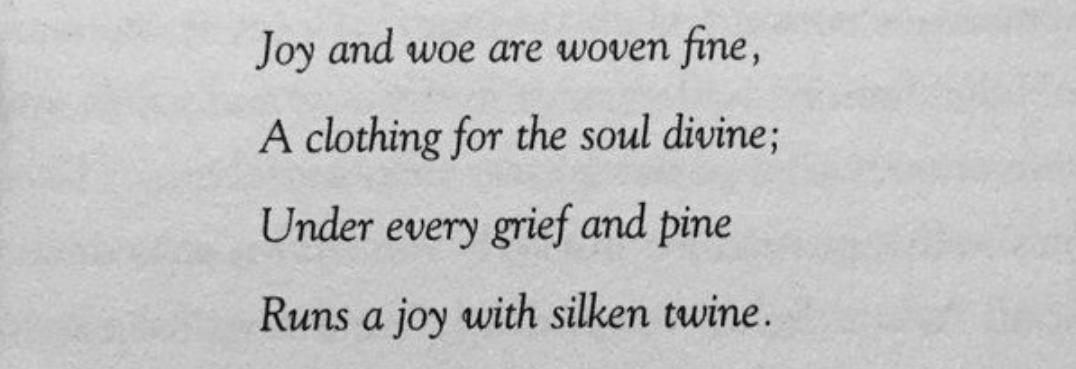
From William Blake’s “Augeries of Innocence” (1863)
Blake was right that “joy and woe are woven fine.” The Bible does not pretend otherwise. But it also insists that joy can be persistent.
This Christmas, joy may not look like cheerfulness. It may look, instead, like awareness or steadiness. It may look like Christ with you… which, in the end, is the foundation Scripture gives for joy in the first place.

Adoration of the Shepherds, Gerard van Honthorst
