
On Love: Dante, Beatrice, and Christmas
On Love: Christmas Lessons from Dante by Gabriel Choo
This is part four of our four-part Advent series written by our teachers reflecting on a new advent theme and how that theme is reflected in the Magdalen curriculum. This post comes rather late, but we hope you enjoy reading it!
I am continually amazed by the power of our curriculum to read us. It has been 19 years since I first read Dante back in high school, and I haven’t stopped thinking about it and learning from it since then. For me, Dante attempts to answer a fundamental question: What does earthly love have to do with Divine love?
In our Omnibus: On Faith class, the theme of rightly ordered love emerges early and builds throughout the year. We read Augustine’s struggles with lesser loves in Confessions, and Dante, Petrarch, and the Pearl poet’s individual struggles with human love wracked by grief. Love may look both similar and different between all of these writers’ experiences, but it is Dante’s story that has captured me, perhaps because his transformation by love is the kind of transformation that I long for myself.
Like Dante, I know that love that tutors me, shapes me, and corroborates what all lovers know: that looking with love and being looked upon with love is to see the face of God.
Sounds good, but what does that look like (haha)?
In seeking to answer the question of how human love and divine love relate to one another, Dante starts his answer with another universal human feeling: lostness:
Midway this way of life we're bound upon,
I woke to find myself in a dark wood,
Where the right road was wholly lost and gone.
Inferno, Canto 1, translated by Dorothy Sayers
Dante starts the journey toward love in the Divine Comedy with the bewildering feeling of realizing he is lost: he once was on the correct path and knew where he was going, but opening his eyes now, he no longer recognizes where he is or how to get back to where he wants to go. He’s in the dark and afraid.
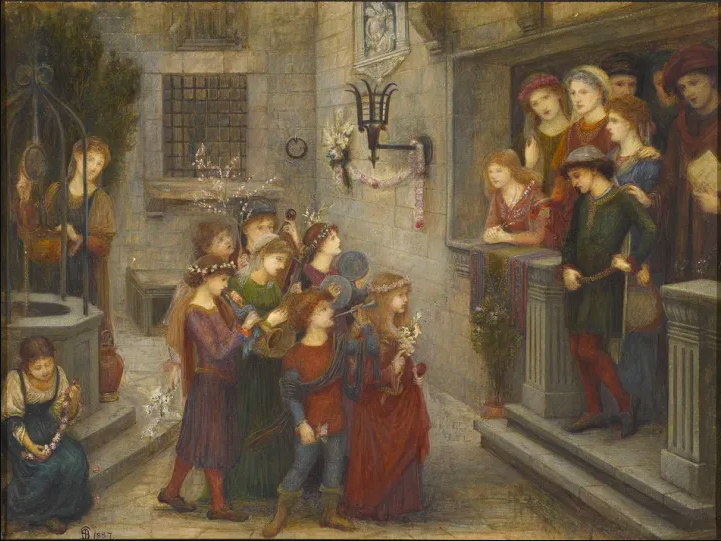
Marie Spartali Stillman, The May Feast at the House of Folco Portinari, depicting Dante and Beatrice’s first meeting as children.
In his real life, Dante had seen the girl called Beatrice in his city of Florence in the 13th century. He was nine years old, and she was eight. Despite their youth, that one moment of meeting transformed Dante forever. He records the words his inner spirit spoke to him in the moment he first beheld Beatrice in the Vita Nuova:
Apparuit iam beatitudo vestra.
Your beatitude has now appeared.
Vita Nuova 1
Beatitude, and indeed Beatrice’s name, implies perfect happiness, blessedness, and even the perfection of sanctification. Dante later describes the change that has come over him because of this meeting:
My lady makes all gracious with her gaze:
bearing the Lord of Love within her eyes,
what she looks upon she dignifies.
Vita Nuova 12
Being looked upon by Beatrice has an uplifting and transformational effect on Dante. He notes that after seeing her, “I tell you that whenever and wherever she appeared, by virtue of my hope in her marvelous greeting, no one could be my enemy; on the contrary, I became possessed by a flame of charity that made me forgive whoever had hurt me, and were someone to ask me any question at that moment, my response would have been, simply, ‘Love,’ my expression clothed in humility” (Vita Nuova 5). Just the sight of Beatrice was enough for Dante’s affections in the day-to-day matters of life to be transformed and sanctified.
This talk of Beatrice as beatitude may seem to some a bit overblown, or perhaps even idolatrous. And indeed, that is something that Dante seems to wrestle with in The Divine Comedy. When Beatrice dies at age 24, Dante is left alive, grieving and lost, and this is part of the trouble he finds himself in at the beginning of The Divine Comedy. Grief seems in part to have clouded his memory of Beatrice, and thus his knowledge of the right path. When Dante finally ascends to the top Mount Purgatory to reach Earthly Paradise and at last beholds Beatrice again, she chastises him for turning his eyes away from her in his grief. If his love and his vision of her, now sanctified in Paradise, had been constant, he would never have wandered from the true path and needed saving from peril.
But not until he walks through hell and purgatory does he recognize the fullness of the grace that Beatrice has been to him. As Dante and Beatrice ascend to the heavens, Beatrice fixes her eyes on the splendor of God and the glory of heaven. Dante tries to look where she looks, but his human eyes are too weak to look directly at the blinding brightness. Instead, he looks to Beatrice, whose eyes reflect those splendors to him–he can see heaven by looking into her eyes. Her eyes reflect back to him the joy, beauty, and love of the presence of God.
Dante shouts the truth we all suspect, the hope we hold dear, the ache we are (to borrow from C.S. Lewis) almost too embarrassed to speak about: every love is a reflection of God’s love, and the truer the love, the closer it draws us to God. God’s power is specifically instantiated in each loving relationship, and it is what moves us to become better than we are.
Love is not only a great thing, it is THE power that moves everything in the universe. Dante describes at the end of Paradise, as he gazes finally upon God himself,
Thus was my mind intent on only one thing:
to gaze ever more deeply into the Light,
for the more I saw, the more I yearned to see!
…
I saw within those depths how all created things
are contained there, bound by love into one great volume,
whose pages are written on and scattered across the universe.
Paradiso 33, translated by Michael F. Meister
Dante’s new vision shows him not only how all goods pale in comparison to the source of goodness itself, but also how all things are bound together by Love. For Dante, to behold that Light is to be consumed within it, so changed that one would never think of turning away, because everything within Divine Love is good, and everything outside that might seem perfect is defective. Dante began his journey only hoping to look once more upon Beatrice, and at that time that grace was sufficient enough to turn his will and desires toward what is good. He could hardly have known the greater glory that awaited him at the end of his ascent. In the final lines of the Divine Comedy, as Dante’s vision of the Triune God begins to fade before his eyes, he says
Already were all my will and my desiresturned—as a wheel in equal balance—by
The Love that moves the sun and the other stars.
Paradise 33, translated by Anthony Esolen
God’s Love hounds us, pursues us, relentlessly hunts us. It does not rest, it is not weary, it will seek us out until it finds us and brings us home to Himself. The Lord of Love is not content to stay up in heaven until we find him–instead, he made himself small and came to seek us and save us on earth. Love Himself came down to us at Christmas, the very Love that moves the sun and the furthest stars. And the world has never been the same.
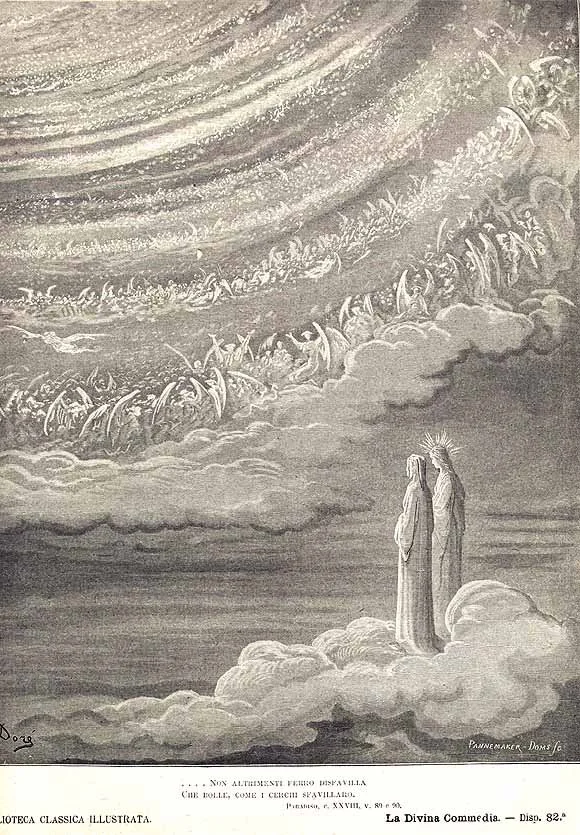
Dante and Beatrice behold the Primum Mobile.
